
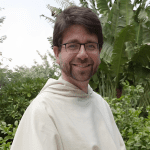
Djamel Djazouli, Denis Gril and Omero Marongiu-Perria
A round table leaded by Adrien Candiard, OP (IDEO)
At the French Institute in Egypt
icon-calendar Friday November 30ᵗʰ, 2018 at 6:00 p.m

It is true that interreligious dialogue has long been the initiative of Christians, however, more and more Muslim voices are now being heard, calling for specifically Qurʾānic and Prophetic foundations of the encounter with non-Muslims to be unearthed. Brother Adrien Candiard, a PhD student in Islamic studies and member of IDEO, led a round table discussion between three French-speaking Muslim scholars: Djamel Djazouli, a Qurʾān specialist and director of the An-Nour Institute (opens in a new tab) in Cergy-Pontoise, Denis Gril, a Sufi specialist and professor emeritus at the University of Aix-Marseille, and Omero Marongiu-Perria, a sociologist of religions and researcher at the Institute for Religious Pluralism and atheism (opens in a new tab) (IPRA).
icon-video-camera Watch the video (mostly in French). (opens in a new tab)
If the Qurʾānic message is centered on the unicity of God, it is to better highlight the diversity that God wanted for humanity, a human diversity of communities and rites that can truly express the richness of the divine unicity. Beyond the dialogue that we can have among ourselves, and in a more fundamental way, God is in dialogue with the universe.
This infinite divine depth cannot be said in simple and unambiguous words, which is why the verses of the Qurʾān often take the form of paradoxes, holding at the same time apparently contradictory expressions: the Qurʾān is the ultimate truth and, at the same time, only God knows who is well guided; or the only religion is Islam and, at the same time, the Prophet Muḥammad will intercede for all communities on the judgment day.
We are therefore called upon to reconsider our conceptions of what truth is, not as a univocal content that we could assert to others, but as a reality that everyone must receive, and in front of which everyone must take positions and make choices, that will necessarily be different for everyone. Islam therefore calls everyone to move forward without fear on this path that ultimately leads to God, and to make their own choices, in dialogue with one another.